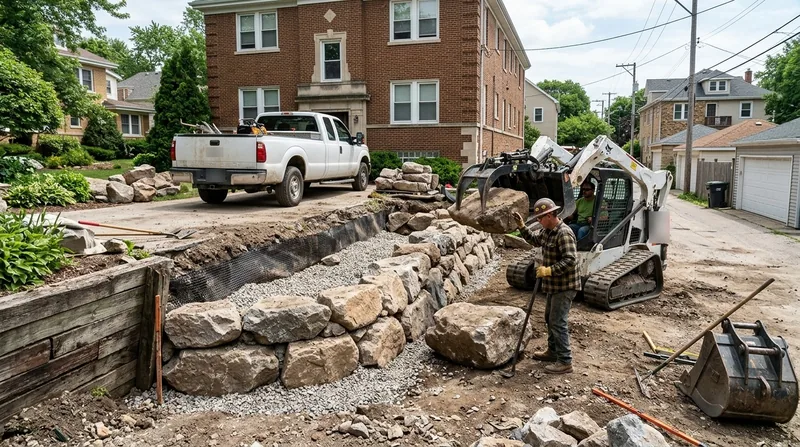




Boulder and natural stone retaining walls in Chicago solve one of the toughest landscape problems on the flat former lakebed: grade changes that need to look natural, drain properly, and survive the freeze-thaw cycle. Chicago's dense glacial clay, high water table near the lakefront and river branches, and deep winter frost demand walls that shed water and move with the ground. Boulder and natural stone walls, machine-placed on a compacted base with proper drainage, give you a durable, finished look that fits ravine lots, river-valley yards, and naturalized landscapes across the city. Whether you're stabilizing a sunken garden in Lincoln Park, managing a driveway cut in the Bungalow Belt, or terracing a sloped lot in the suburbs, natural stone delivers both function and character. We install, repair, and replace these walls to meet Chicago's building code and your site's actual drainage and soil conditions.
Why Boulder and Natural Stone Walls Matter in Chicago's Clay-Heavy Terrain
Chicago's landscape is defined by subtle but constant grade changes: raised front yards to keep basements dry, areaway stairwells for sunken units, driveway cuts that expose clay banks, alley ramps, and parkway beds that need containment. The city sits on a dense glacial clay base with a high water table, especially near the lakefront and the branches of the Chicago River. Winter frost heave and spring thaw create tremendous pressure on walls that don't drain. Poured concrete cracks and spalls, aging railroad ties rot, and CMU blocks fail when water freezes behind them. Boulder and natural limestone walls, properly installed with a compacted base and drainage layer, shed water and move with seasonal ground shifts instead of fighting them.
- We set natural stone on a compacted gravel and sand base that allows water to flow away from the wall face.
- Machine placement ensures each stone sits stable and level, resisting frost heave and tilting over multiple freeze-thaw cycles.
- The open-jointed construction lets hydrostatic pressure drain instead of building up behind the wall.
- Natural stone blends with Chicago's existing landscape character, from ravine edges to restored yards.
- Boulder and limestone walls typically outlast concrete and timber by decades when properly drained and set.
These walls handle Chicago's actual climate and soil without the maintenance burden of failing concrete or rotting timber.
Key info: Chicago's building department requires a permit for walls above roughly 4 feet measured from the footing, or when a wall supports a surcharge such as a driveway or structure. Engineered drawings may be required for tall or tiered walls. Always verify thresholds and setback rules with your local building department, as requirements vary by neighborhood and aldermanic district. See the City of Chicago Department of Buildings for current code and permit requirements.
How We Install Boulder and Natural Stone Walls: The Chicago Process
Installation starts with a site visit to assess soil, water flow, and the grade change you need to manage. We dig out the foundation to stable clay or bedrock, set a compacted gravel base, and lay each stone by machine with a drainage layer behind it. The goal is a wall that sheds water, sits level, and won't heave or tilt when the ground freezes and thaws. In Chicago's dense clay, we often need to install a perforated drain pipe at the base and run it to daylight or a storm drain so water doesn't pool behind the wall. Every wall is built to meet Chicago building code and your site's actual conditions. Related work like retaining wall drainage is often part of the job to ensure long-term performance.
- We excavate the footing to firm clay or bedrock and compact the base with gravel and sand.
- Natural stone or boulders are positioned and set by machine in running bond or similar pattern for stability.
- A geotextile fabric and drainage gravel layer go behind the wall to let water flow downslope.
- A perforated drain line at the base carries water away from the wall to a daylight outlet or storm drain.
- The wall face is finished to your preferred look, from tight-jointed to rustic, and backfill is compacted in lifts.
- Final grading and any plantings or coping stone complete the job.
The entire process respects Chicago's water table and frost line so your wall stays true for decades.
Local example: A raised driveway in Park Ridge exposing a 6-foot clay bank needed a stone wall to hold the cut and keep the driveway from settling. We dug to stable clay, set a 3-foot compacted base with Lemont limestone boulders, installed a drain line at the base that ran to the alley storm drain, and finished the face with tight-jointed natural stone. The wall has held level through two winters and spring thaws without movement or seepage.
Boulder and Natural Stone Wall Methods: Comparing Approaches
| Approach | Description | Best for |
|---|---|---|
| Machine-placed boulders | Large natural boulders (2 to 10 tons) set by excavator with drainage base and fabric behind. | Ravine edges, naturalized landscapes, walls 4 to 8 feet tall, high-visibility front yards. |
| Stacked natural stone (Joliet or Lemont limestone) | Cut or split limestone blocks stacked and set with gravel and drainage behind; tight or rustic jointing. | Formal garden terraces, driveway cuts, properties where a finished stone appearance suits the architecture. |
| Mortared stone (limited use) | Stone set with mortar joint; requires experienced mason and careful drainage design to avoid water trap behind wall. | Shorter walls (under 3 feet) or highly formal settings where a tight, uniform joint is essential. |
| Tiered or stepped stone walls | Multiple walls at different heights, each with its own base and drainage, following steep or irregular slopes. | Large grade changes, ravine lots, properties where a single tall wall would exceed code or look unnatural. |
Each method is chosen based on your site's slope, soil, water flow, and the visual character you want to achieve. We assess the specific conditions at your Chicago property and recommend the approach that will last longest and look best.
Boulder and Natural Stone Walls Cost in Chicago: What to Expect
Boulder and natural stone retaining walls in Chicago typically start at $25 per square foot for a basic machine-placed boulder wall with compacted base and drainage, and range from $30 to $50 per square foot or more depending on stone type, wall height, site access, and the complexity of drainage requirements. A 50-foot wall that is 4 feet tall (200 square feet) might run $5,000 to $10,000 before permits, site prep, or additional drainage work. Taller walls, tiered systems, premium stone like Lemont limestone, difficult access, or extensive grading and drainage can push costs higher. The factors that move a job up in price are wall height, linear footage, whether the site requires special equipment or multiple visits, and the distance water must be carried away from the wall.
We recommend getting two or three estimates from licensed contractors so you can compare approaches, drainage design, and warranty. A low bid that skips proper drainage or uses inadequate compaction will fail in Chicago's freeze-thaw cycle. Our free estimate includes a site walk, assessment of soil and water conditions, and a realistic price range so you know what you're paying for. Visit our pricing page for more detail on how we break down costs and what factors affect your final quote.
Boulder and Natural Stone Walls Near Me: What Chicago Homeowners Should Know When Hiring
Hiring a contractor for boulder and natural stone walls means checking three things: licensing and insurance, understanding whether your project needs a permit, and getting multiple estimates so you can compare quality and approach. Chicago and most suburbs require contractors to be licensed and insured. A permit is typically required for walls above roughly 4 feet measured from the footing, or when a wall supports a surcharge like a driveway or deck. Your contractor should be able to walk you through the permit process and handle any engineering drawings required by your local building department. Ask for references from recent jobs in your neighborhood so you can see how the walls have held up through a winter or two.
- Verify that the contractor is licensed and insured, and ask for a copy of their certificate of insurance.
- Ask whether your project requires a permit and who will handle the application and inspection.
- Get at least two or three written estimates that break down the cost by square footage, stone type, and drainage work.
- Check references from at least two recent jobs in Chicago or a nearby suburb, and ask how the walls performed through winter.
- Clarify the warranty or guarantee, especially for settling, tilting, or water seepage in the first year.
- Confirm that the contractor will handle site cleanup, haul away excavated soil, and restore the landscape after the wall is built.
A good estimate should include a site visit, a clear description of the drainage plan, and an honest timeline. We offer free, no-obligation estimates within 24 hours at (872) 253-4548, and we handle permitting, engineering, and all site work so you don't have to coordinate multiple trades. Contact us today to schedule your free assessment and get a realistic price for your project.
Boulder & Natural Stone Walls in Chicago: Pricing Guide
| Service | Price | Details |
|---|---|---|
| Boulder and natural stone walls (machine-placed) | Starting at $25/sq ft | Compacted base, drainage layer, and machine placement; cost increases with wall height, stone size, and site access difficulty |
| Stacked limestone or premium stone finish | Starting at $35/sq ft | Cut or split natural stone set in running bond or tight joint; includes drainage and compacted base; higher cost reflects material and finish labor |
| Tiered or stepped stone walls | Starting at $40/sq ft per tier | Multiple walls at different heights, each with separate base and drainage; cost reflects additional excavation, compaction, and drainage line work |
| Drainage system installation and repair | Starting at $800 to $2,500 | Perforated drain line, gravel layer, and daylight outlet or storm drain connection; essential for Chicago clay and high water table areas |
| Site prep, grading, and restoration | Included in base estimate | Excavation, compaction, backfill, and final grading are part of the wall installation; no separate charge for standard prep and cleanup |
| Free estimate and site visit | No charge | Response within 24 hours; includes soil assessment, drainage evaluation, and realistic price range; no obligation to book |
Indicative pricing, the exact cost depends on square footage, finish, and site access. Free personalized estimate within 24h at (872) 253-4548.


