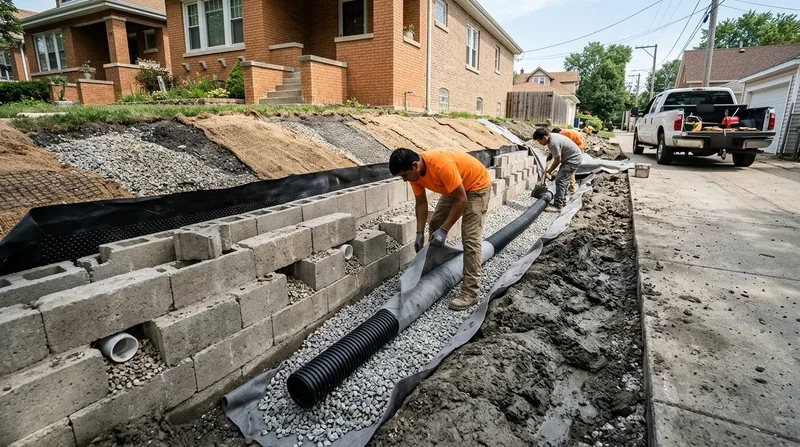




Retaining Wall Drainage in Chicago is not optional for walls that last. Chicago sits on a dense glacial clay base with a high water table, especially near the lakefront and river branches, combined with deep winter frost that cycles repeatedly from November through March. When water saturates the clay behind a wall and freezes, it expands with tremendous force, pushing the wall forward, cracking it, or toppling it entirely. This freeze-thaw cycle is the number one cause of retaining wall failure in the city. A properly designed drainage system relieves that water pressure before it becomes a problem, protecting your wall investment and your property. We install French drains, weep holes, gravel backfill systems, and waterproofing membranes that work together to move water away from the wall face and footing. Call us at (872) 253-4548 for a free estimate, or learn more about our retaining wall repair services if your wall is already showing signs of damage.
Why Retaining Wall Drainage Fails in Chicago's Climate
Chicago's flat terrain and dense clay soil create ideal conditions for water to pool and remain trapped behind retaining walls. Unlike sandy or well-draining soils, glacial clay holds moisture for months, especially after spring thaw or heavy rain. When that saturated clay freezes solid in winter, the expanding ice exerts hydrostatic pressure that no wall can resist indefinitely. Older walls built without proper drainage, such as railroad tie walls and early poured concrete walls throughout the Bungalow Belt, fail at predictable rates. Even newer segmental block and concrete walls fail prematurely if their backfill and drainage design do not account for Chicago's water table and frost depth.
- Water trapped behind a wall creates hydrostatic pressure that increases with depth and saturation, pushing the wall outward and destabilizing its footing.
- Freeze-thaw cycles in Chicago's winters cause soil expansion that can move a wall several inches per season, cracking it or tilting it permanently.
- Poorly compacted or clay-heavy backfill absorbs and holds water instead of allowing it to drain, accelerating wall failure.
- Weep holes and French drains that are clogged, crushed, or improperly installed allow water to re-accumulate, negating their protective effect.
- Walls without a gravel-to-perforated-pipe drainage core fail within 5 to 15 years in Chicago, depending on exposure and soil saturation.
Proper drainage design is the single most cost-effective way to prevent these failures and extend wall life to 30, 40, or 50 years.
Key info: A retaining wall in a sunken garden unit in Logan Square or a raised front yard in Pilsen is at high risk of failure if it lacks a French drain system. The clay soil in these neighborhoods holds water like a sponge, and spring thaw creates a perfect storm for hydrostatic pressure. We have repaired and re-drained dozens of failed walls in these areas, adding 20+ years of life by installing proper drainage after the fact.
For more information on how drainage relates to wall repair, visit our leaning and collapsed wall repair page. The Illinois Department of Financial and Professional Regulation (ILFPR) requires all contractors to be licensed; verify your contractor's license at cyberdriveillinois.com before hiring.
How We Install Retaining Wall Drainage Systems in Chicago
Our drainage design process begins with a site assessment to evaluate the wall's exposure, the soil composition, the water table depth, and the frost line (typically 40 to 48 inches in Chicago). We then specify the appropriate combination of methods: French drains along the wall footing, weep holes at regular intervals in the wall face, gravel backfill with a perforated pipe core, and waterproofing membranes on the wall face if needed. Installation follows the footing excavation and before backfill, so the system is fully integrated into the wall structure. Every component is sized and spaced to handle Chicago's seasonal water load and frost expansion.
- We excavate behind the wall footing to expose the base and assess existing soil and drainage conditions.
- We install a perforated drain pipe (typically 4-inch PVC) at or below the footing level, sloped to daylight or a sump, surrounded by gravel.
- We drill or form weep holes through the wall face at 4 to 6-foot intervals, starting 12 inches above grade, to allow water to escape during heavy rain or thaw.
- We backfill with clean gravel (not clay-rich soil) to a height of 2 to 3 feet above the footing, creating a drainage zone that prevents water accumulation.
- We cap the gravel with landscape fabric and topsoil to prevent sediment from clogging the gravel and to allow planting or lawn above.
- We test the system by running water and confirming that it flows freely to the daylight outlet or sump pump.
This multi-layer approach ensures that water cannot pool or freeze behind your wall, no matter how wet Chicago's spring or how cold the winter.
Example: A homeowner in Evanston had a 6-foot poured concrete wall supporting a driveway. After two winters, the wall was leaning 3 inches out of plumb and showing cracks at the base. We excavated the footing, installed a 4-inch perforated drain with gravel backfill, and added five weep holes. Two years later, the wall has settled back to plumb, the cracks have stabilized, and the homeowner has peace of mind knowing the drainage system is managing the clay and groundwater. The total cost was $4,200, a fraction of the cost of wall replacement.
Learn more about our concrete retaining wall services for walls that may benefit from drainage upgrades.
| Drainage Method | Description | Best for |
|---|---|---|
| French Drain (Footing Level) | 4-inch perforated PVC pipe surrounded by gravel, installed at or below the footing, sloped to daylight or sump. | All retaining walls in Chicago; essential for walls over 4 feet or in high water table areas near lakefront or river branches. |
| Weep Holes | 4-inch diameter openings drilled or cast through the wall face, spaced 4 to 6 feet apart horizontally and vertically, starting 12 inches above grade. | Existing walls lacking drainage, or new walls where a French drain is not feasible; provides emergency relief for trapped water. |
| Gravel Backfill with Perforated Core | Clean, angular gravel (no clay or fines) backfilled behind the wall and above the footing, with a perforated pipe running vertically or horizontally to collect water. | New wall installations and major repairs; prevents water accumulation in the backfill zone and allows free drainage downslope. |
| Waterproofing Membrane | Asphalt or polymer coating applied to the wall face before backfill to reduce water absorption into porous materials such as concrete or block. | Porous wall materials (concrete, CMU, stone) in high-saturation environments; extends wall life by reducing freeze-thaw damage to the wall itself. |
| Sump Pump System | Electric pump installed in a pit at the base of a French drain, activated when water level rises, pumping water away from the wall to daylight or storm drain. | Walls in low-lying areas or where gravity daylight drainage is not possible; typical in areaway stairs and sunken garden units in Chicago. |
Retaining Wall Drainage Cost in Chicago: What to Expect
Retaining wall drainage costs in Chicago start at $2,500 for a basic French drain and weep hole system on a short section (under 20 feet) with accessible excavation. A typical residential project, such as adding drainage to a 40-foot wall or installing a complete drainage system on a new 6-foot wall, ranges from $4,000 to $8,000. Larger projects, tiered walls, or those requiring a sump pump system can exceed $10,000. The primary factors that affect cost are the length of the wall, the depth of the footing excavation, the accessibility of the site (narrow alley, tight space, or proximity to structures), the type of wall material (poured concrete is faster to drill than block or stone), and whether a sump pump is needed.
If your wall is leaning, cracked, or showing signs of water damage, drainage work is often the most cost-effective repair. We recommend getting 2 to 3 estimates from licensed contractors to compare methods and pricing. Our free estimate includes a site walk, soil and water assessment, and a written proposal with a timeline and warranty. Call (872) 253-4548 or visit our pricing page for detailed cost breakdowns by wall type and drainage method.
Retaining Wall Drainage Near Me: What Chicago Homeowners Should Know Before Hiring
Ask for references from recent drainage projects in your neighborhood, such as Lincoln Park, Lakeview, or the Bungalow Belt, and call at least two to confirm quality and timeline. Confirm that the contractor understands Chicago's permit requirements, which vary by municipality: some areas require a permit for walls over 4 feet, others for any wall that supports a surcharge (driveway, deck, or structure). Always contact your local building department or village engineer before work begins to verify setback rules, property line restrictions, and drainage easements. If your property is in an HOA or historic district, check those restrictions as well.
- Verify the contractor's Illinois license at cyberdriveillinois.com and confirm their insurance is current before signing a contract.
- Request a detailed written estimate that specifies the drainage method, materials (pipe size, gravel type, membrane), and labor scope.
- Ask whether the contractor will obtain permits on your behalf or if you are responsible for filing; clarify who pays permit fees.
- Confirm the warranty on drainage work, including how long the contractor guarantees that weep holes will remain clear and that the French drain will function without clogging.
- Get the timeline in writing, including start and completion dates and whether the work is weather-dependent or can proceed year-round.
A reputable contractor will welcome these questions and provide clear answers. Contact us at (872) 253-4548 or visit our contact page to schedule a free estimate and speak directly with a drainage specialist about your wall and your options.
Retaining Wall Drainage in Chicago: Pricing Guide
| Service | Price | Details |
|---|---|---|
| French drain system (up to 30 linear feet) | Starting at $2,500 | Includes footing excavation, 4-inch perforated pipe, gravel backfill, and labor; accessible residential sites in Chicago. |
| Weep hole installation (per wall face) | Starting at $1,200 | Drilling or forming 4 to 6 holes through existing wall, spacing 4 to 6 feet apart; cost depends on wall material and thickness. |
| Complete drainage system (new or major repair wall) | Starting at $4,500 | French drain, weep holes, gravel backfill, waterproofing membrane, and landscape fabric; typical 40 to 60-foot residential wall. |
| Sump pump drainage system | Starting at $3,500 | Includes pit excavation, pump installation, discharge line, and electrical hookup; required where gravity daylight drainage is not possible. |
| Complex or large-scale drainage project | On estimate | Tiered walls, deep excavation, poor access, or multiple sump pumps require site assessment and custom engineering before pricing. |
| Free estimate and site assessment | Free | Response within 24 hours at (872) 253-4548; includes soil and water evaluation, drainage recommendations, and written proposal. |
Indicative pricing, the exact cost depends on square footage, finish, and site access. Free personalized estimate within 24h at (872) 253-4548.


