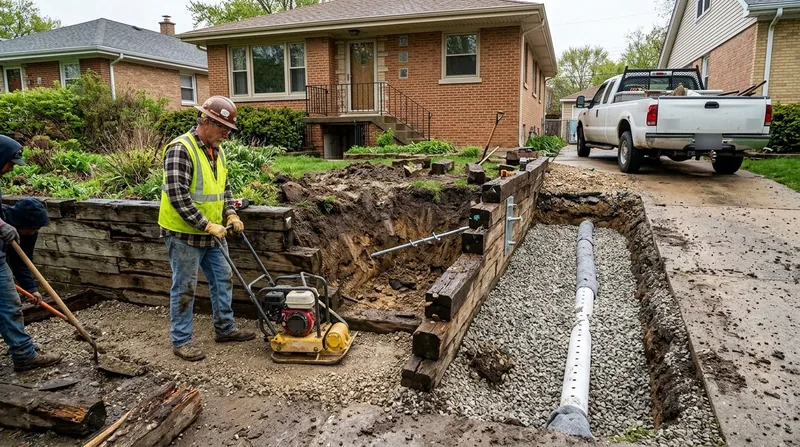




Retaining Wall Repair in Chicago is a critical service for homeowners dealing with the relentless effects of freeze-thaw cycles, saturated glacial clay, and spring thaw water that has nowhere to drain. Chicago sits on a flat former lakebed with dense clay soil, a high water table near the lakefront and river branches, and deep winter frost that heaves walls upward and cracks concrete from the inside out. The city's 1920s brick bungalows, greystones, two-flats with sunken gardens, and frame cottages all depend on retaining walls to hold back grade changes, basement areaway stairwells, raised front yards, driveway cuts, and alley ramps. When a wall leans, bows, cracks, or heaves, the damage compounds fast. We stop that damage before collapse, using drainage correction, tieback anchors, and partial rebuilds tailored to Chicago's brutal climate and soil conditions. Call us at (872) 253-4548 for a free estimate.
Why Retaining Wall Repair Matters in Chicago's Tough Climate
Chicago's freeze-thaw cycle is the enemy of retaining walls. Water enters cracks in poured concrete, CMU block, segmental walls, and aging railroad ties. When temperatures drop below freezing, that water expands with tremendous force, widening cracks and pushing the wall outward. Spring thaw adds hydrostatic pressure from saturated clay soil behind the wall. Without proper drainage and repair, a wall that leans 2 inches today can collapse within 3 to 5 years. Catching the problem early saves money, prevents foundation damage to adjacent structures, and keeps your property safe.
- We identify the root cause: freeze-thaw heave, poor drainage, soil settlement, or structural overload from a surcharge.
- We correct drainage by installing perforated pipe, gravel backfill, and surface swales to move water away from the wall.
- We install tieback anchors or helical anchors to stabilize bowing or leaning walls without full removal.
- We rebuild sections of failed concrete, CMU, block, or timber walls to restore structural integrity and extend life.
- We verify compliance with Chicago and local building department rules before work begins.
Early repair stops small problems from becoming expensive emergencies.
Key info: Chicago's dense glacial clay and high water table mean most retaining wall failures are drainage failures. A wall that appears to be failing structurally often just needs perimeter drainage installed or corrected. We assess every wall for water management before recommending anchor or rebuild work. See our retaining wall drainage service for details.
For reference on Chicago permit rules and wall height thresholds, consult the City of Chicago Department of Buildings.
How We Diagnose and Repair Retaining Walls in Chicago
Every repair job starts with a site inspection. We photograph the wall, measure lean and crack width, probe soil moisture and drainage, and assess the material (poured concrete, CMU, segmental block, limestone, or railroad ties). We check for water seeping from behind or below the wall, and we look at the grade and surcharge above. From there, we develop a repair plan that stops the failure mode specific to your wall and your property. Some jobs need drainage only. Others need anchors. Some need a partial or full rebuild. We explain the options and the cost before we start.
- We excavate and inspect the wall footing, backfill, and surrounding soil to understand settlement and water flow patterns.
- We install or correct perimeter drainage, including perforated drain pipe, filter fabric, and gravel backfill.
- We install tieback anchors or helical anchors if the wall is bowing or leaning but structurally sound.
- We rebuild failed sections of wall using matching material, proper footing depth, and correct drainage and backfill.
- We compact backfill in lifts and slope the surface away from the wall to shed water.
The entire process prioritizes stopping water from entering or building up behind your wall.
Example: A homeowner in Lincoln Park noticed her 6-foot poured concrete wall leaning outward and cracking at the mortar joints. We excavated, found the drainage pipe had been crushed and the backfill was saturated clay with no gravel filter. We installed new perforated drain pipe, replaced the backfill with gravel and filter fabric, and installed two tieback anchors to stabilize the lean. The wall stopped moving within 30 days. Total cost was $4,200. No full rebuild needed.
Learn more about leaning and collapsed wall repair for severe cases.
Retaining Wall Repair Methods: What Works in Chicago
| Approach | Description | Best for |
|---|---|---|
| Drainage Correction | Install or replace perforated drain pipe, add gravel backfill and filter fabric, slope surface away from wall. | Walls with seepage, saturation, or poor gravel backfill; first step in most repairs. |
| Tieback or Helical Anchors | Install steel anchors that tie the wall face to stable soil or rock deeper in the ground. | Walls that are bowing or leaning but not cracked through; avoids full rebuild. |
| Partial Rebuild | Remove and replace the top 2 to 4 feet of wall, or rebuild only the failed section; match existing material and footing. | Walls with frost heave, horizontal cracks, or localized collapse; preserves lower wall if sound. |
| Full Reconstruction | Remove entire wall, excavate footing, rebuild with proper depth, drainage, and backfill using new or matching material. | Walls that are unstable throughout, severely cracked, or where anchors alone cannot stabilize. |
| Railroad Tie or Timber Wall Replacement | Remove rotted timber or railroad ties and rebuild with pressure-treated wood, concrete, or block. | Aging timber or tie walls that are collapsing; concrete or block is longer-lasting in Chicago climate. |
Retaining Wall Repair Cost in Chicago: What to Expect
Retaining wall repair costs in Chicago range from $1,500 for drainage correction on a small section to $8,000 to $15,000 for partial rebuilds, and $20,000 or more for full reconstruction of a large wall. The main factors that affect cost are: height and length of the wall, type of material (poured concrete, CMU, block, timber), whether drainage work is needed, soil conditions and footing depth, access for equipment, and whether the job requires an engineered design and permit. A wall that just needs drainage work costs far less than one requiring tieback anchors or a rebuild. A wall in a tight backyard with no equipment access costs more than one on an open lot.
The best way to know your actual cost is to get a free on-site estimate. We come out, assess the wall and the failure mode, and give you a clear price for the repair method we recommend. We also explain what that price includes and what factors might change it. If you need an engineered design for a tall wall or a wall supporting a surcharge, that adds to the cost, but many jurisdictions require it. Check with your local building department about permit thresholds in your area.
For a detailed breakdown of pricing by repair type and job size, visit our full pricing page. Call us at (872) 253-4548 for a free estimate with no obligation.
Retaining Wall Repair Near Me: What Chicago Homeowners Should Know When Hiring
Finding a reliable retaining wall contractor near Chicago means checking three things: licensing and insurance, references from recent jobs, and a clear understanding of permit rules for your area. Illinois requires contractors working on structural repairs to be licensed. Ask for proof of a current Illinois contractor license and general liability and workers' compensation insurance. Get written estimates from at least two contractors so you can compare approach, timeline, and cost. Check references, especially jobs done in your neighborhood or on similar wall types. Ask whether the contractor has experience with Chicago's clay soil and freeze-thaw failures. Finally, confirm with your local building department whether your wall repair needs a permit. Many walls above 4 feet or walls supporting a driveway or structure do. A good contractor will handle permitting as part of the job.
- Verify the contractor holds a current Illinois license and carries general liability and workers' compensation insurance.
- Request at least three recent references from similar wall repairs in Chicago or nearby suburbs.
- Get written estimates that detail the repair method, materials, timeline, and what is included in the price.
- Ask whether the job requires a permit and whether the contractor will pull it and coordinate inspections.
- Confirm the contractor understands Chicago's soil, water table, and freeze-thaw climate and how it affects wall failures.
A contractor who takes time to inspect your wall, explain the problem clearly, and give you options is one worth hiring.
Ready to get started? Contact us for a free estimate at (872) 253-4548. We respond within 24 hours and handle all permitting.
Retaining Wall Repair in Chicago: Pricing Guide
| Service | Price | Details |
|---|---|---|
| Drainage Correction and Gravel Backfill | Starting at $1,500 | Perforated drain pipe, filter fabric, and gravel backfill installation; cost scales with wall length and excavation depth needed |
| Tieback or Helical Anchor Installation | Starting at $3,500 | Two to four anchors per wall; stabilizes bowing or leaning walls without full rebuild; price depends on anchor depth and soil conditions |
| Partial Wall Rebuild | Starting at $5,000 | Remove and rebuild top 2 to 4 feet of wall with proper footing, drainage, and backfill; cost depends on wall height, length, and material type |
| Full Wall Reconstruction | On estimate | Complete removal and rebuild of entire wall; requires site inspection to assess footing depth, soil stability, and material choice |
| Estimate and Site Inspection | Free | No obligation; we photograph, measure, diagnose the failure mode, and provide a written repair plan with pricing within 24 hours |
Indicative pricing, the exact cost depends on square footage, finish, and site access. Free personalized estimate within 24h at (872) 253-4548.


