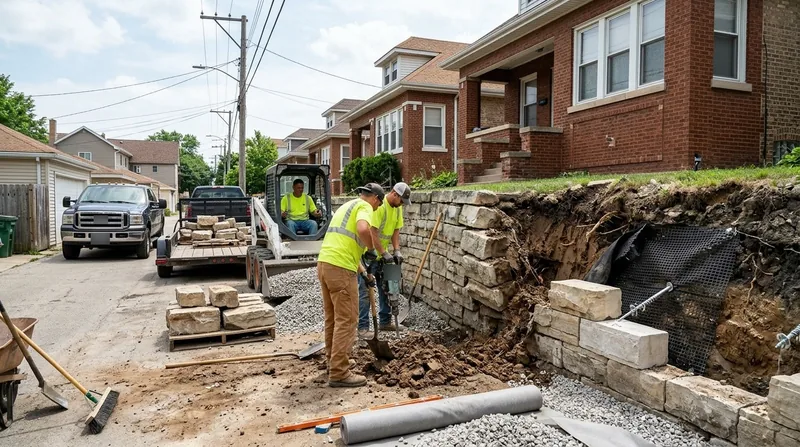




Leaning & Collapsed Wall Repair in Chicago demands fast, expert response. Chicago's retaining walls fail from freeze-thaw cycles, spring thaw saturation in glacial clay, and decades of frost heave in a city built on a former lakebed with a high water table. A wall that leans or bulges today can collapse tomorrow, threatening property lines, driveways, and foundation stability. We stabilize failing walls with tieback anchors, correct drainage to relieve water pressure, and rebuild when a wall has passed its limit. See our full retaining wall repair services for more detail on prevention and maintenance.
Why Leaning and Collapsed Retaining Walls Are a Chicago Problem
Chicago sits on dense glacial clay that expands and contracts with freeze-thaw cycles. Winter temperatures drop below freezing for weeks at a time, ice lenses form in saturated soil, and spring thaw releases enormous hydrostatic pressure against any wall. Older walls, especially poured concrete and railroad tie construction common in the Bungalow Belt, were rarely designed with adequate drainage. When water has nowhere to go, it pushes the wall forward, creating the lean, bulge, or outright failure we see across Lincoln Park, Lakeview, Logan Square, and neighborhoods from Evanston to Naperville.
- Freeze-thaw cycles in glacial clay expand soil behind the wall and push it outward every winter.
- High water tables near the Chicago River branches and lakefront saturate clay and multiply hydrostatic load.
- Aging railroad tie and concrete walls from the 1920s-1960s lack interior drainage systems or weep holes.
- Spring thaw and heavy rain concentrate water pressure against the wall face, causing failure within days.
- Sunken garden units in greystones and two-flats create areaway walls that absorb runoff and fail fastest.
Catching a lean early and installing drainage or tieback anchors saves money and prevents a total collapse that can damage utilities, neighboring property, and the home's structural integrity.
Key info: Chicago's Department of Buildings requires a permit for retaining walls over approximately 4 feet measured from footing, or any wall supporting a surcharge such as a driveway or structure. Engineered drawings are required for tall or tiered walls. Always verify setback and property-line rules with your local building department before repair begins, as requirements vary by ward and municipality.
For regulatory guidance, see Chicago Department of Buildings Permits and Requirements.
How We Repair Leaning and Collapsed Walls in Chicago
Our process starts with a site visit to assess the wall's tilt, bulge pattern, soil saturation, and drainage condition. We photograph the failure, probe the soil behind the wall, and check for standing water or seepage. From there, we determine whether the wall can be stabilized with anchors and drainage, or whether partial or full reconstruction is the only safe path. Every repair is designed to address the root cause, not just the symptom.
- We assess the lean angle, bulge pattern, and soil moisture behind the wall using field tools and visual inspection.
- We identify the drainage failure point, whether clogged weep holes, missing perforated pipe, or grade that channels water into the wall.
- We discuss repair options with you, including tieback anchors, interior drainage installation, or full rebuild.
- We obtain any required permits from the local building department and confirm property-line and setback compliance.
- We install tiebacks, drainage, or rebuild the wall in sections to minimize disruption to your yard and driveway.
- We backfill with drainage-friendly gravel and confirm the wall is plumb and the soil drains freely.
Most stabilization jobs take 3 to 5 days; full rebuilds can run 1 to 2 weeks depending on wall height and access. We clean up daily and leave the site safe and passable.
Example: A leaning poured-concrete wall in Lincoln Park was pushing 2 inches forward per year. We installed tieback anchors every 4 feet, opened weep holes, and ran perforated drain pipe at the base. The wall stopped moving within weeks, and the homeowner avoided a $12,000 full rebuild. See our retaining wall drainage solutions for more on preventing future failure.
Repair Methods for Leaning and Bulging Walls
Not every failing wall needs to be torn down. The method we choose depends on the wall's material, the lean severity, soil conditions, and your budget. Below are the most common approaches we use across Chicago and the suburbs.
| Approach | Description | Best for |
|---|---|---|
| Tieback Anchors | Steel cables anchored to deadman blocks or living trees deep behind the wall, pulling it back to plumb. | Moderate lean (1 to 3 inches), stable soil, walls that can be straightened without full rebuild. |
| Interior Drainage & Weep Holes | Installation of perforated drain pipe at wall base and opening or drilling weep holes to release water pressure. | Saturated soil, spring thaw failure, walls that are sound but pushed by water load. |
| Partial Rebuild | Removal and reconstruction of the upper 2 to 4 feet of wall, installing new drainage and base drainage at the same time. | Upper section failure, compromised concrete or block, walls too far gone for anchors alone. |
| Full Reconstruction | Complete removal and rebuild using modern drainage design, proper compaction, and engineered material (poured concrete, segmental block, or stone). | Severe lean or collapse, failed timber or railroad tie walls, walls with structural damage or settlement. |
Each method is priced and timed according to wall height, material, and site access. We provide a detailed estimate before work begins, and we handle all permitting with the city or municipality.
Leaning & Collapsed Wall Repair Cost in Chicago: What to Expect
The cost of leaning and collapsed wall repair in Chicago ranges from $2,500 for drainage and stabilization work to $15,000 or more for full reconstruction, depending on wall height, material, access, and the extent of failure. A 4-foot poured-concrete wall with moderate lean and poor drainage might cost $3,500 to $6,000 to stabilize with anchors and interior drain pipe. A 6-foot segmental block wall that has partially collapsed could run $8,000 to $12,000 to rebuild. Variables that drive cost include wall height, material (poured concrete is typically less expensive than stone; segmental block sits in the middle), soil conditions, whether the wall supports a driveway or structure (which requires engineered design), and site access for equipment.
We recommend getting 2 to 3 estimates from licensed contractors, as repair methods and material choices vary. Always verify that the contractor is licensed and insured, and ask to see references from similar jobs in your neighborhood. See our full pricing overview for cost breakdowns by wall type and repair method.
Every estimate from Chicago Retaining Wall is free, no obligation, and provided within 24 hours. Call us at (872) 253-4548 to schedule your site visit.
What to Look for When Hiring a Leaning & Collapsed Wall Repair Contractor Near Me
Choosing the right contractor for wall repair near Chicago is as important as the repair itself. A poorly installed tieback or drainage system can fail in two years, leaving you with the same problem and an empty wallet. Ask to see proof of insurance and a copy of the Illinois license. Check references, especially jobs from the last two years on similar wall types and repair methods.
Understand the permitting requirements for your specific wall and location, as rules vary by ward in Chicago and by municipality in the suburbs (Evanston, Oak Park, Skokie, Park Ridge, Des Plaines, Wilmette, Highland Park, and others). Some walls require engineered drawings; others do not. Your contractor should know the local rules and handle permitting as part of the service. If you live in an HOA, confirm that the repair plan complies with any architectural guidelines before work begins.
Get the estimate in writing, including the repair method, materials, timeline, and warranty. A reputable contractor will stand behind their work with a 5 to 10 year warranty on drainage and structural repair. Do not accept a verbal estimate or a contract with blank pricing. If something feels rushed or vague, call another contractor. Quality wall repair is a competitive market in Chicago, and you have choices.
Ready to get started? Contact us for a free, no-obligation estimate. We serve Chicago and surrounding areas, respond within 24 hours, and have completed hundreds of wall repairs across the city and suburbs.
Leaning & Collapsed Wall Repair in Chicago: Pricing Guide
| Service | Price | Details |
|---|---|---|
| Drainage and stabilization (anchors, weep holes, interior drain pipe) | Starting at $2,500 | Moderate lean, stable wall structure, saturated soil or spring thaw failure, no full rebuild required |
| Partial wall rebuild (upper 2 to 4 feet, includes new drainage) | Starting at $5,500 | Upper section compromised, concrete or block deterioration, moderate height wall, site access adequate for equipment |
| Full wall reconstruction (complete removal and rebuild, engineered if required) | Starting at $8,500 | Severe lean or collapse, failed timber or railroad tie walls, tall walls above 6 feet, structural damage or settlement |
| Complex or large-scale job (tiered walls, multiple sections, specialty materials) | On estimate | Scope requires on-site assessment before pricing, includes engineered design, permitting, and multi-week timeline |
| Travel and site visit | Included | No separate call-out or mileage fee for Chicago and surrounding service areas including suburbs |
| Free estimate | No obligation | Response within 24 hours at (872) 253-4548, detailed site assessment and repair plan proposal included |
Indicative pricing, the exact cost depends on square footage, finish, and site access. Free personalized estimate within 24h at (872) 253-4548.


