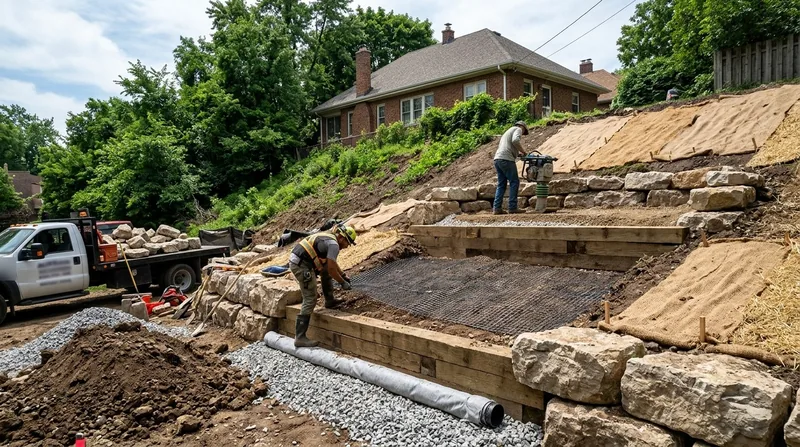




Slope stabilization and erosion control in Chicago protects your home, driveway, and yard from the relentless pressure of unstable soil and water runoff. Chicago sits on a flat glacial lakebed with dense clay, a high water table, and deep winter frost that creates ideal conditions for slope failure. When spring thaw and heavy rain hit saturated clay banks, backyard slopes collapse, basement walls crack, and driveways settle. We stabilize ravine edges, lakefront bluffs, river banks, and backyard slopes with terraced retaining walls, geogrid reinforcement, and drainage systems that stop erosion before it reaches your foundation. Chicago Retaining Wall designs and builds slope stabilization systems that hold soil in place for decades, even through Chicago's punishing freeze-thaw cycles.
Why Slope Stabilization Matters in Chicago's Clay and Water-Heavy Landscape
Chicago's glacial clay is dense, tight, and holds water like a bathtub. When frost heave lifts soil in winter and thaw opens cracks in spring, water finds those gaps and destabilizes everything downslope. Backyard slopes that seem stable for years can fail suddenly after a heavy rain or a harsh winter. Lakefront bluffs and river banks erode faster than most homeowners expect. A failing slope doesn't just destroy landscaping, it cracks foundations, undermines driveways, and threatens neighboring properties.
- We build terraced walls that break long slopes into stable increments and reduce pressure on any single wall.
- We install geogrid reinforcement behind walls to anchor soil and resist lateral force from saturated clay.
- We run perimeter and subsurface drainage to channel water away from the slope and reduce hydrostatic pressure.
- We use concrete, block, stone, or timber walls depending on the soil type, height, and aesthetic fit.
- We grade and compact backfill carefully to prevent settling and maintain long-term stability.
Proper slope stabilization stops erosion, protects your property, and adds usable land and safety to your yard.
Key info: Chicago's lakefront neighborhoods in Lincoln Park and Lakeview face bluff erosion from wave action and groundwater seepage. Inland slopes in areas like Oak Park and Naperville fail from freeze-thaw and poor drainage. We've stabilized eroding bluffs in Wilmette and slumping ravine banks in Des Plaines. Every slope is different, and every fix starts with understanding how water moves through your soil.
For more on how water undermines walls, see our guide to retaining wall drainage in Chicago.
The City of Chicago and suburban building departments have specific rules about permits for walls above 4 feet and for walls that support surcharges like driveways or structures. Always verify with your local building department before starting work. For Chicago-specific permit guidance, consult the Chicago Department of Buildings permit page.
How We Stabilize Slopes: Our Process in Chicago
Slope stabilization starts with a clear picture of what's failing and why. We visit your property, dig test pits to check soil type and groundwater, measure the slope angle and height, and trace water flow patterns. Then we design a system that combines walls, reinforcement, and drainage to lock the slope in place. Our goal is to build once and never touch it again.
- We assess soil type, depth to bedrock or water table, and slope angle to determine wall height and reinforcement needs.
- We design a tiered or single-wall system with geogrid layers to anchor soil and resist outward pressure.
- We install perimeter and subsurface drainage pipes to collect water and route it away from the slope.
- We build the wall with proper footing depth, backfill, and compaction to ensure long-term stability.
- We grade and seed or landscape the slope to prevent surface erosion and improve drainage.
The entire process typically takes 2 to 4 weeks depending on slope size, wall height, and weather. Chicago's spring and fall are ideal for this work, as the ground is workable and not frozen.
Example: A homeowner in Park Ridge had a 12-foot backyard slope that was sliding toward the house after two heavy springs. We built a terraced system with two 6-foot block walls, geogrid reinforcement, and a perimeter drain. The slope stabilized immediately, and the terraces created flat planting beds. The entire job took 3 weeks and required a permit from the Park Ridge Building Department.
Learn more about our retaining wall installation process and how we handle complex slopes.
Slope Stabilization Methods: Which Approach Works Best for Your Slope
| Approach | Description | Best for |
|---|---|---|
| Terraced walls with geogrid | Multiple shorter walls stacked with reinforcement layers between each tier. Distributes force and improves drainage. | Long slopes over 15 feet high, saturated clay, areas with poor surface drainage. |
| Single tall wall with drainage | One engineered wall with deep footing, geogrid, and perimeter drain. Used when space is limited or slope is steep. | Shorter slopes under 12 feet, property-line constraints, stable soil below clay layer. |
| Concrete retaining wall | Poured or precast concrete wall, monolithic and strong. Resists freeze-thaw and holds up to 50 years in Chicago clay. | High-load slopes, areas near structures, lakefront bluffs, maximum durability needed. |
| Segmental block wall | Interlocking SRW blocks stacked with geogrid layers. Flexible, easy to build in stages, and repairs are simple. | Moderate slopes, residential yards, tiered designs, when future adjustments may be needed. |
| Boulder and natural stone walls | Stacked Joliet or Lemont limestone or large boulders with gravel backfill. Aesthetic and permeable. | Lower slopes under 8 feet, decorative effect, good drainage, rustic neighborhoods. |
Slope Stabilization and Erosion Control Cost in Chicago: What to Expect
The cost of slope stabilization and erosion control in Chicago depends on slope height, length, soil type, wall material, and drainage complexity. A simple 4-foot block wall on a short slope may run $3,000 to $6,000, while a terraced system on a 20-foot ravine slope with geogrid and extensive drainage can reach $15,000 to $30,000 or more. The best starting point is a free on-site estimate, which lets us measure the slope, check soil and water conditions, and quote accurately.
Factors that move the price up include deep frost footing (required in Chicago), geogrid reinforcement layers, perimeter and subsurface drainage installation, engineered designs for tall or tiered walls, and site access challenges. If the slope is near a foundation, basement window, or neighbor's property, the design and safety requirements increase. Always get 2 or 3 estimates so you understand the range and the reasoning behind each quote.
Visit our pricing page for detailed guidance on cost factors and what's included in a typical job. Call us at (872) 253-4548 for a free estimate with no obligation.
Slope Stabilization and Erosion Control Near Me: What to Look for When Hiring a Contractor
Hiring the right contractor for slope stabilization is critical because the work is structural, involves heavy equipment, and affects your home's safety and resale value. Look for a licensed and insured contractor with experience in Chicago clay and freeze-thaw conditions. Ask to see examples of completed slopes, especially multi-year-old work that has survived a full Chicago winter. Check references with homeowners in your neighborhood or nearby suburbs like Evanston, Skokie, or Downers Grove.
- Verify that the contractor is licensed as a home contractor or general contractor in Illinois and carries liability and workers compensation insurance.
- Ask whether the contractor pulls permits for your local building department and handles all engineering and design work.
- Request references from at least three completed slope stabilization projects, preferably in Chicago or a similar clay-heavy area.
- Get written estimates that break down materials, labor, drainage, and any engineering or permit fees.
- Confirm that the contractor offers a warranty on the wall and drainage system, typically 1 to 5 years depending on material.
A professional contractor will also advise you on HOA rules if you live in a restricted community and will guide you through the permit process with your local building department.
Ready to stabilize your slope? Contact Chicago Retaining Wall for a free estimate at (872) 253-4548. We serve Chicago and all surrounding suburbs, and we respond within 24 hours.
Slope Stabilization & Erosion Control in Chicago: Pricing Guide
| Service | Price | Details |
|---|---|---|
| Free on-site estimate | Free | Site visit, soil assessment, slope measurement, and written quote with no obligation to hire us |
| Short slope stabilization | Starting at $3,500 | Single 4-6 foot block or concrete wall with basic drainage, less than 30 linear feet |
| Terraced slope system | Starting at $8,500 | Two or more walls with geogrid reinforcement, perimeter drain, and grading, 40-60 linear feet total |
| Complex or large-scale stabilization | On estimate | Ravine edges, bluff erosion, slopes over 20 feet, multiple tiers, engineered design required |
| Travel and site visits | Included | No mileage fee or travel charge within Chicago and all surrounding service areas |
Indicative pricing, the exact cost depends on square footage, finish, and site access. Free personalized estimate within 24h at (872) 253-4548.


